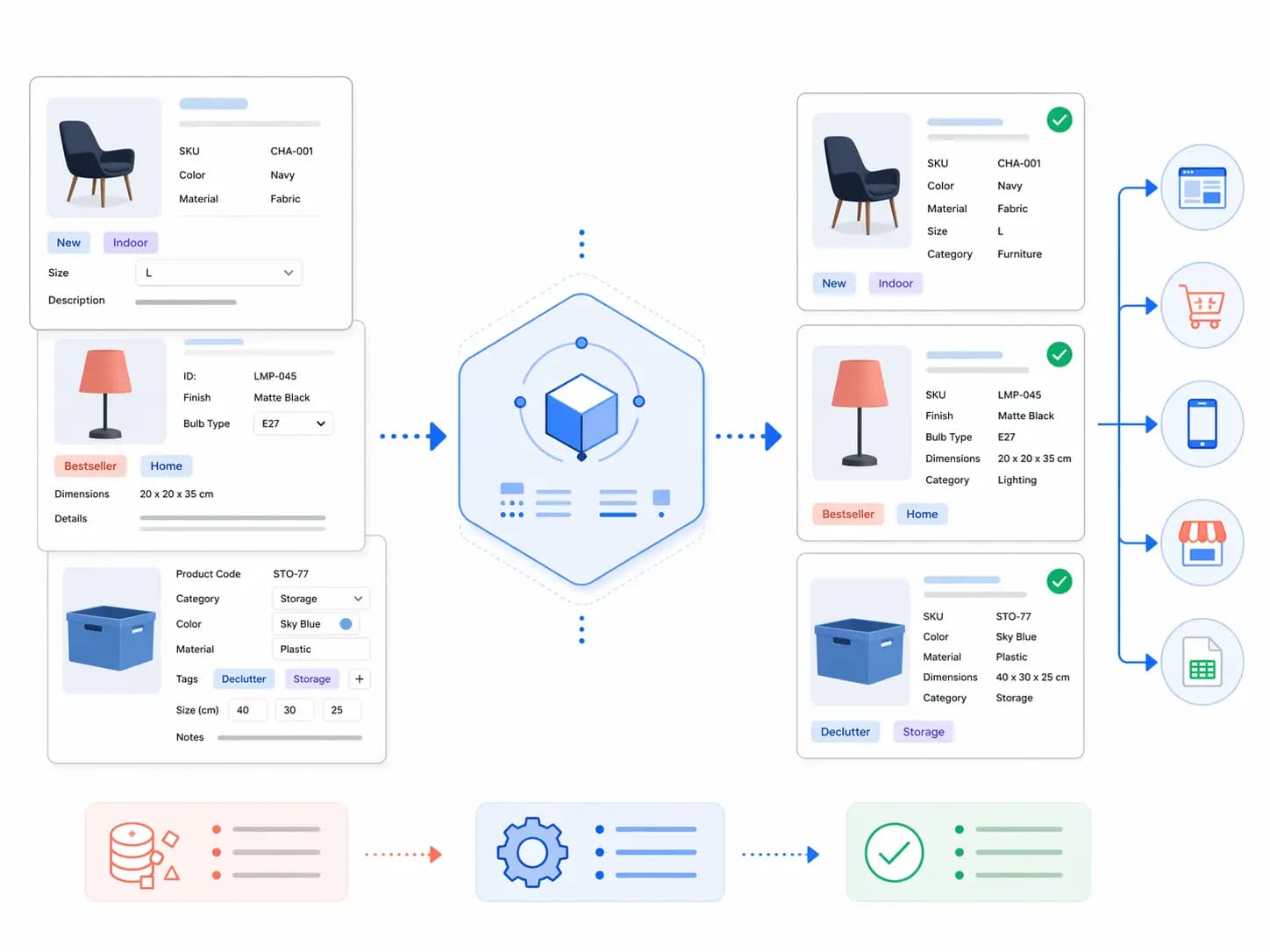
Short answer: PIM manages sellable product information; MDM governs shared business master data; DAM manages digital assets; and PXM turns reliable product content into stronger, channel-specific customer experiences. They overlap, but they are not interchangeable.
PIM, MDM, DAM, and PXM are often presented as competing acronyms. That framing leads teams to buy the wrong system or expect one tool to solve a problem owned by another part of the stack. The useful question is not “which acronym wins?” It is which data, asset, governance, and customer-experience problems do we need to solve first?
This guide separates the four categories, explains where they connect, and gives ecommerce teams a practical way to decide what belongs in their next project.
At a glance: PIM, MDM, DAM, and PXM
| System | Primary job | Typical owner | It is not a replacement for |
|---|---|---|---|
| PIM | Create, enrich, validate, and distribute sellable product information | Ecommerce, merchandising, product operations | ERP, enterprise MDM, or a full DAM |
| MDM | Govern trusted master data and relationships across business domains | Data governance, IT, enterprise architecture | A product-content workflow |
| DAM | Store, organize, approve, and distribute rich media and documents | Brand, creative, content operations | Structured product-data management |
| PXM | Improve how product content is tailored and experienced across touchpoints | Ecommerce, marketing, merchandising | The governed product-data foundation |
What PIM does
Product information management (PIM) is the operating layer for commercial product data: titles, descriptions, attributes, specifications, variants, categories, identifiers, related products, and channel-ready content. A PIM gives contributors one structured product record to enrich, validate, approve, and publish to the storefront, marketplaces, feeds, print, or partner systems.
PIM is usually the first priority when product launches depend on spreadsheets, suppliers use inconsistent vocabulary, variants are difficult to manage, or each sales channel requires different fields and formats. It helps teams model a parent product and its variants, control attribute values, measure completeness, and prevent incomplete records from reaching a channel.
If that sounds like your operating reality, start with our guide to PIM and compare it with the limits of spreadsheets for product data .
What MDM does

Team comparing product information management with master data governance
Master data management (MDM) is broader. It establishes governance for the organization’s shared, authoritative data—often products, customers, suppliers, locations, accounts, hierarchies, and reference data. An MDM initiative defines stewardship, matching and deduplication rules, ownership, and the rules by which records become trusted across systems.
Product MDM and PIM can work together. MDM can govern the enterprise product identity and relationships with suppliers, locations, or other entities; PIM can manage the rich commercial content needed to sell the product. The boundary differs by organization, so agree field ownership early. For example, an ERP may own cost and inventory, MDM may own the enterprise identifier, and PIM may own the marketing title, attributes, and channel copy.
Choose MDM first when the urgent problem spans multiple data domains or when duplicate and conflicting records across ERP, CRM, procurement, and commerce prevent reliable operations. Choose PIM first when the pain is specifically product enrichment, variants, completeness, and channel output. Many growing commerce teams need PIM before an enterprise-wide MDM program.
What DAM does

Product assets and product data managed together in an ecommerce workflow
Digital asset management (DAM) manages files: product photography, video, manuals, safety sheets, packaging artwork, brand assets, and rights information. A DAM makes assets searchable, tracks versions and approvals, and helps teams distribute the approved file instead of a stale copy.
DAM is not a product-data model. It does not normally manage a variant hierarchy, category-specific attribute requirements, or channel mappings. A PIM is also not a full DAM. It may store or reference assets and associate them with products, but a dedicated DAM is better suited to rights, renditions, versioning, creative workflows, and large media libraries.
The common pattern is DAM + PIM: DAM remains the system of record for the file, while PIM decides which approved assets belong on which product, variant, market, or channel. That separation avoids a frequent error: a correct image attached to the wrong SKU or an unapproved file appearing on a product page.
What PXM means—and why the term needs care

Consistent product experiences across ecommerce channels and devices
Product experience management (PXM) is best understood as a business approach and capability layer, not a universally standardized standalone system category. It focuses on making product content useful and compelling in the context where a customer encounters it: a storefront, marketplace, search result, campaign, retailer portal, or local market.
PXM capabilities can include channel-specific content, localization, assortment storytelling, rich media, merchandising context, and content-performance feedback. They depend on trustworthy underlying product data. If attributes are incomplete, variants are wrong, or asset approvals are unclear, presentation cannot repair the foundation.
So PIM and PXM are not opposites. PIM makes product information structured, complete, and governed; PXM uses that foundation to make the experience more relevant for a particular customer and channel. Vendors package these capabilities differently, so evaluate the actual workflow—not just the label.
Where the systems overlap
- PIM and MDM: both may hold product identifiers and core attributes. Define which fields are enterprise master data and which are commercial enrichment.
- PIM and DAM: both touch product media. Let DAM govern the file and PIM govern its product and variant association.
- PIM and PXM: both influence channel output. PIM supplies reliable content; PXM adapts that content to the customer experience.
- All four: need shared governance. A system diagram is not enough—teams must agree on ownership, approval rules, identifiers, and change handling.
How to choose the right starting point
Start with PIM when
- product titles, attributes, variants, and channel exports are inconsistent;
- several teams edit product data in different files or systems;
- marketplace or feed requirements create repeated manual cleanup;
- you need completeness rules and a clear “ready to publish” status.
Start with MDM when
- product is only one of several conflicting master-data domains;
- duplicate supplier, customer, location, or product records affect multiple systems;
- you need stewardship, survivorship, and governance at enterprise scale.
Start with DAM when
- teams cannot find approved imagery, documents, or video;
- rights, expiry dates, versions, and creative approvals create risk;
- files are copied into too many folders or storefronts.
Prioritize PXM capabilities when
- the product-data foundation is already reliable but experiences feel generic;
- markets and channels need localized stories, richer media, or tailored assortments;
- you need to connect content quality with merchandising and conversion outcomes.
A practical operating model
For many ecommerce teams, the practical sequence is: define product identity and field ownership; build a usable product-data model in PIM; connect approved assets from DAM; then improve channel and market experiences with PXM capabilities. An enterprise MDM layer may sit alongside this flow when cross-domain governance is required.
Use industry standards where they fit your category and partners. GS1’s Global Data Model, for example, defines foundational attributes used to list, order, store, move, and sell products. It is a useful reference for shared attributes and data-quality conversations, but it does not choose your internal system of record for you. Read the GS1 Global Data Model overview .
Questions to ask before you buy
- Which system owns each important field, and who can change it?
- Do we need to govern only product content, or products plus customers, suppliers, and locations?
- Are asset rights and creative approvals a separate operational bottleneck?
- Which channels, locales, and partners have different content requirements?
- Can the platform model variants, relationships, completeness, approvals, and exports without custom workarounds?
- How will we measure a better result: faster launches, fewer errors, higher completeness, or stronger channel performance?
Bottom line
PIM, MDM, DAM, and PXM solve connected but different problems. Do not select by acronym. Select the smallest coherent combination that fixes the bottleneck you have today and leaves clear ownership for tomorrow. For most commerce teams, reliable structured product data is the foundation—then assets, governance, and customer experiences become much easier to scale.
Next steps: assess your current process with the PIM Readiness Score , explore product catalog management , or review LynkPIM plans .