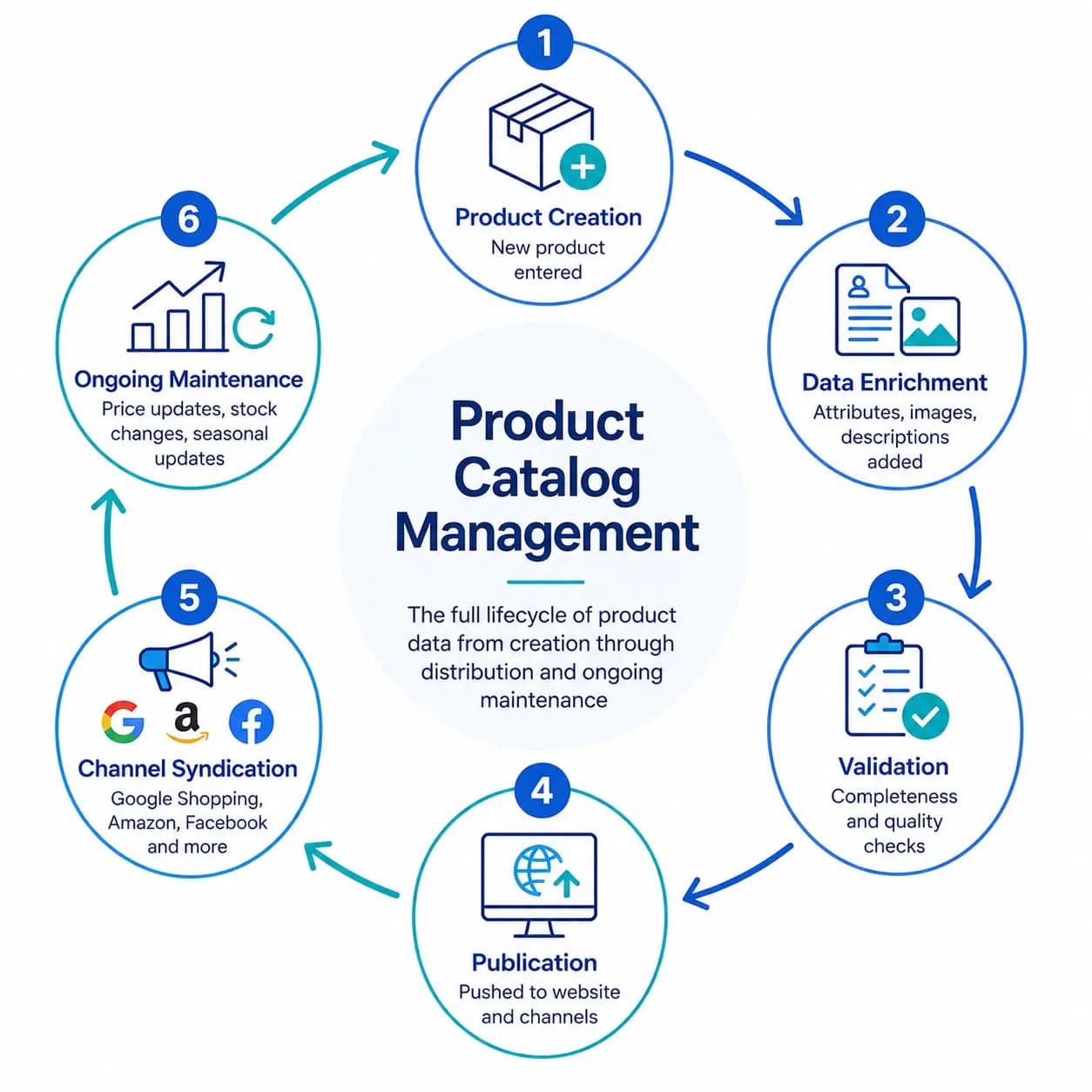
- Product catalog management is the ongoing work of creating, organizing, enriching, validating and publishing product data so every channel shows the same accurate information.
- It is a process with owners and rules, not a tool. Software helps only once the process is defined.
- Most catalog problems trace back to five causes: no single source of truth, no taxonomy, no validation, no publishing workflow and no audits.
- Spreadsheets work at small scale. The break point is usually many channels, many suppliers or many people editing at once, not a fixed SKU count.
- Start with a 90-day plan: baseline the quality, fix the top categories, assign owners, then automate the checks.
A product catalog is the structured record of everything you sell: titles, descriptions, specifications, prices, identifiers, images, documents, categories and the relationships between them. Managing it well decides whether customers can find products, whether marketplaces accept your listings, and whether your team spends its week selling or repairing spreadsheets.
This guide covers the full picture: what catalog management is, the process step by step, who should own what, how to choose between spreadsheets, a commerce platform and a PIM, which metrics to track, and a practical 90-day plan. It links to detailed guides on each topic, so you can go deeper where you need to.

Ecommerce manager organizing a product catalog in PIM software
What is product catalog management?
Product catalog management (also written product catalogue management) is the set of processes, rules and systems used to build and maintain product information across its lifecycle. It covers getting data in from suppliers and internal teams, structuring it, improving it, checking it, and sending it to the places customers see it.
A short definition: catalog management makes sure the right product data is complete, correct and consistent everywhere you sell.
It is related to, but broader than, a few neighbouring terms:
- Product information management (PIM) is the type of software most often used to manage a catalog. See what is PIM .
- Inventory management tracks stock and locations. It uses catalog data but is a different discipline.
- Master data management (MDM) governs enterprise data across many domains. Product is one of them. The PIM vs MDM vs DAM vs PXM comparison explains the differences.
- Digital asset management (DAM) stores images, video and documents. A catalog references assets that a DAM or PIM holds.
For a shorter introduction, read what is product catalog management . This guide goes further into process, roles, tools and measurement.
Why catalog management matters
Product data is the raw material of ecommerce. Weak data shows up as weak results, usually in several places at once:
| Symptom | Typical data cause | Business effect |
|---|---|---|
| Customers cannot find products | Inconsistent categories, missing attributes, no synonyms | Lost sales, high search exit rate |
| Marketplace or Google Shopping rejects listings | Missing identifiers, wrong category, policy fields empty | Products not shown, wasted ad budget |
| Returns and support tickets rise | Wrong dimensions, unclear variants, mismatched images | Higher cost per order |
| Launches take weeks | Manual copy-paste between files and systems | Slow time to market |
| Teams argue about which file is right | No single source of truth | Rework and low trust in data |
The real cost of bad product data goes through how these costs add up.
The seven components of catalog management
Catalog management is easier to run when you split it into seven parts, each with an owner and a quality standard.
1. Data onboarding
Getting data in from suppliers, ERP exports, manufacturer feeds and internal teams. The key task is mapping each source to your own fields and values, and keeping the original value for traceability. See how to clean supplier product data .
2. Taxonomy and classification
The category structure that decides where a product lives and which attributes apply. A good taxonomy has one primary place per product and controlled attributes for everything else. Start with the product taxonomy guide .
3. Attributes and variants
The specification fields and the model for options such as size and colour. Decide what belongs to the parent product and what belongs to each variant, and use controlled values wherever customers filter. The product data modeling hub covers this in detail.
4. Enrichment
Adding the content that helps people buy: clear titles, descriptions, bullets, size guides, use cases, images and documents. See product data enrichment .
5. Quality and validation
Rules that check completeness, accuracy, consistency, uniqueness and freshness before data is published. The product data quality scorecard shows how to measure it.
6. Publishing and syndication
Sending approved data to your storefront, marketplaces, feeds, print catalogs and partners, each with its own format and required fields. See the guides to Google Shopping feeds and Amazon feeds .
7. Governance
Who can change what, how changes are approved, and how the rules themselves evolve. See product data governance .

Supplier product data transformed into a structured ecommerce product catalog
The product catalog management process, step by step
Every product moves through a lifecycle. Writing it down, with an owner and a check at each step, is the single most useful thing you can do for catalog quality.
| Step | What happens | Check before moving on |
|---|---|---|
| 1. Intake | Product data arrives from a supplier, ERP or internal team | Required identifiers present; source recorded |
| 2. Classify | Product is assigned one primary category | Category is a leaf; attribute set applied |
| 3. Normalize | Units, names and values mapped to controlled lists | No free-text colours, sizes or materials |
| 4. Enrich | Titles, descriptions, images and documents added | Content standards met for the category |
| 5. Validate | Rules run for completeness, accuracy and uniqueness | No hard-stop errors; score above threshold |
| 6. Approve | A reviewer signs off, with change history kept | Approval recorded |
| 7. Publish | Data is sent to each channel in its required format | Channel validation passes |
| 8. Monitor | Rejections, returns and search behaviour reviewed | Issues feed back into rules |
| 9. Retire | Discontinued products are archived and redirected | No live links or feed entries remain |
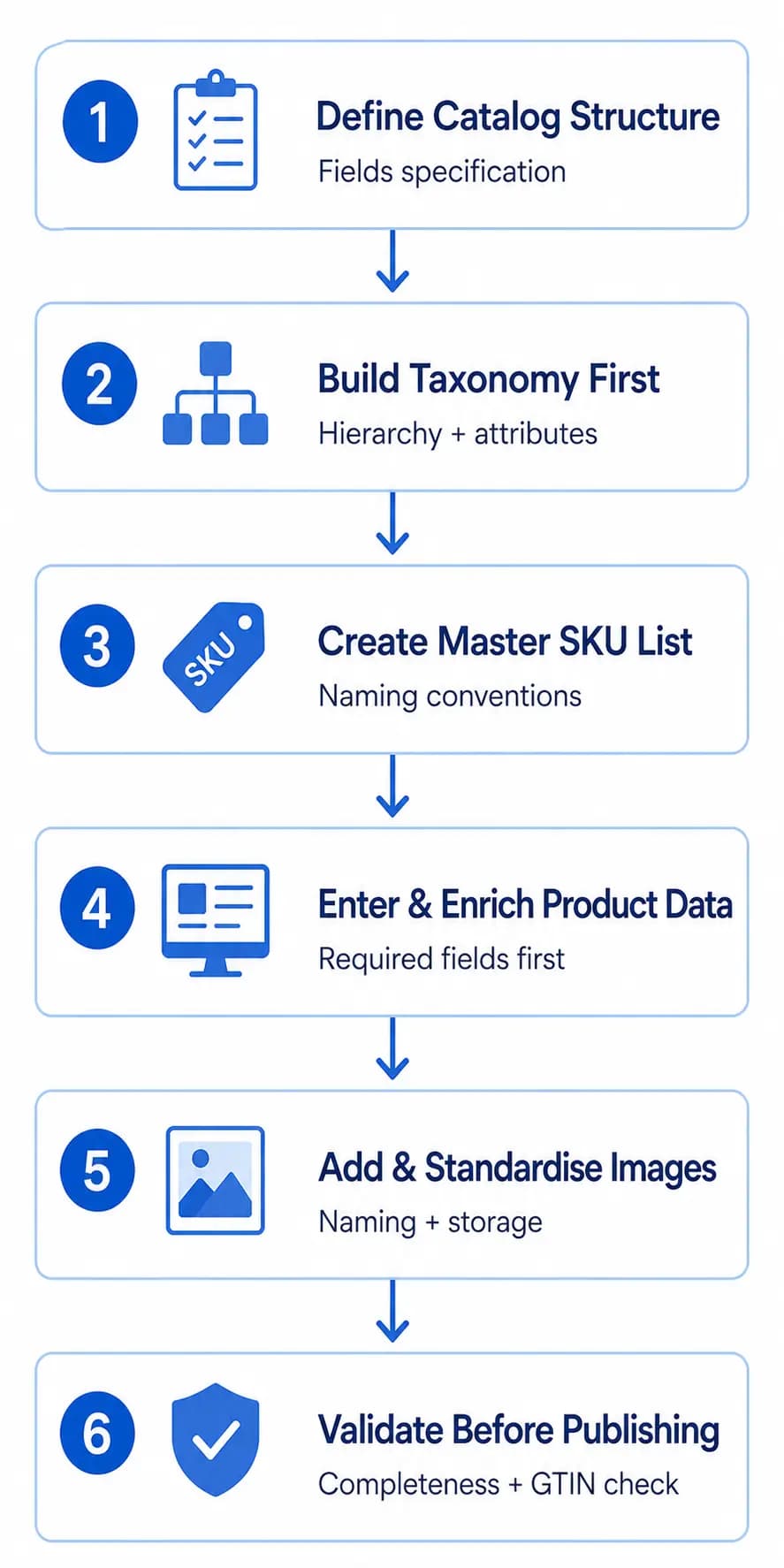
If you are creating a catalog from scratch, how to build a product catalog walks through the order: structure first, taxonomy second, SKU conventions third, then required attributes, image standards and validation.
Common catalog problems and how to fix them
| Problem | Why it happens | Fix |
|---|---|---|
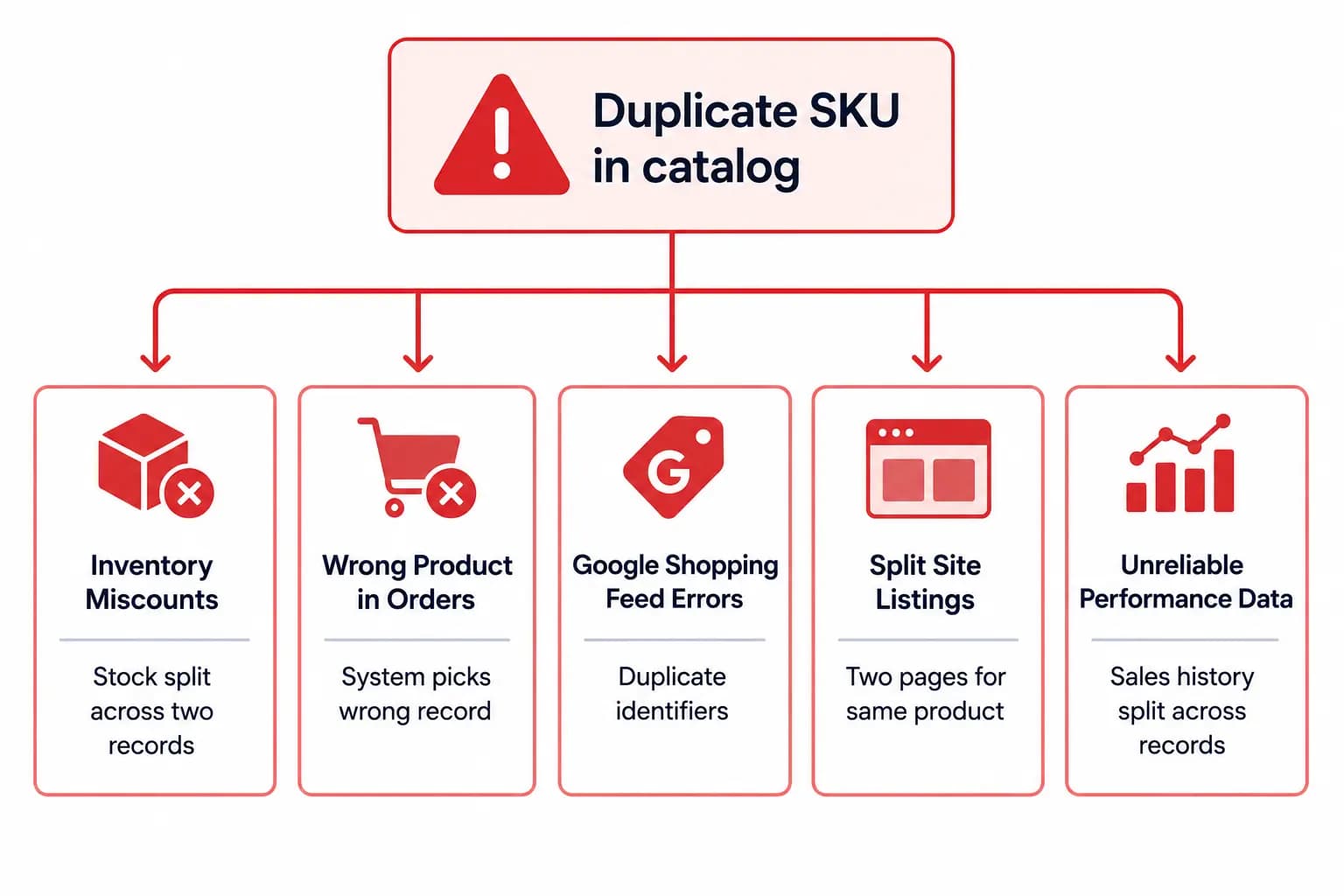
| Duplicate products and SKUs | Multiple import sources, no matching rule | Match on SKU, GTIN and name similarity; block new duplicates. See duplicate SKUs . |
| Inconsistent values (“Grey”, “Gray”) | Free-text fields, many editors | Controlled value lists with synonyms mapped to one canonical value |
| Missing identifiers | Supplier data incomplete | Make GTIN or MPN a hard stop for channels that require it. See GTIN and UPC compliance . |
| Wrong or missing categories | Taxonomy mixed with merchandising | One primary category; collections for campaigns. See the taxonomy audit checklist . |
| Different data in each channel | Edits made directly in each platform | Edit once in the source; publish out |
| Stale prices or availability | No sync from ERP or inventory | Scheduled sync; freshness rule on time-sensitive fields |
| Nobody owns quality | Shared responsibility, no accountability | Named data steward per category |
Who owns what: roles and responsibilities
Catalog quality fails when everyone assumes someone else owns it. A simple ownership model is enough to start.
| Role | Responsible for |
|---|---|
| Catalog or product data manager | Overall process, standards, data model and reporting |
| Category manager or merchandiser | Category structure, assortment and content priorities for their range |
| Data steward | Daily quality: fixing exceptions, approving values, supplier follow-up |
| Content or SEO specialist | Titles, descriptions, landing pages and search terms |
| Channel or feed owner | Mappings, feed rules and rejection handling per channel |
| IT or integration owner | Connections to ERP, commerce platform and PIM |
| Compliance reviewer (where relevant) | Claims, documents, certificates and regulated fields |
In small teams one person holds several roles. That is fine, as long as the responsibilities are written down. The governance guide includes approval workflow patterns.
Catalog management systems: spreadsheet, platform or PIM?
A catalog management system is whatever holds your source product data and applies your rules. Most businesses move through several stages.
| Option | Works well when | Starts to hurt when |
|---|---|---|
| Spreadsheets | One person, one or two channels, a small range | Several editors, many suppliers, version confusion, channel-specific formats |
| Commerce platform only (for example a storefront admin) | One storefront; simple products | You add marketplaces, languages or rich supplier data the platform does not model |
| ERP product records | Operational data like cost, stock and supplier codes | Marketing content, rich attributes and channel formats are needed |
| PIM | Many sources, many channels, shared ownership, validation needs | The process behind it is undefined; the tool then reproduces the mess |
When does a business need a PIM?
Typical signs include several people editing the same files, supplier data arriving in different formats, repeated listing rejections, slow launches, and no agreed answer to “which version is correct”. The article 12 signals you’ve outgrown spreadsheets lists them in detail, and PIM vs spreadsheets compares the two approaches. You can check your own position with the PIM Readiness Score .
What to look for in catalog management software
- A flexible data model: category-specific attribute sets, variants, bundles and relationships.
- Controlled values and normalization: mappings from supplier values to your canonical ones.
- Validation rules: required fields by category and channel, with clear exception lists.
- Workflows and audit history: review, approval and rollback.
- Channel publishing: feeds and connectors, with category mappings kept separate from your taxonomy.
- Localization: translations and market-specific overrides.
- Integrations and APIs: for ERP, storefront, DAM and marketplaces.
- Exit options: export of data, taxonomy, mappings and media.
For a structured selection process, use the PIM platform evaluation guide , the RFP question list and the guide to PIM pricing and total cost .
Catalog management software or a managed service?
Some teams outsource part of the work: data entry, enrichment, supplier onboarding or migration. A managed service can help with a backlog, but the rules, ownership and source of truth should stay with you. A sensible split is to keep the data model, approvals and quality standards in-house, and outsource volume work that follows those standards.
Centralized catalog management across channels
Centralized catalog management means one source record per product, edited once, and published to many places. The alternative is the common but costly pattern of editing each channel separately, which causes the “different data everywhere” problem.
- Keep one internal taxonomy and attribute model as the source of truth.
- Maintain a separate, versioned mapping from your categories and attributes to each channel.
- Store channel-specific content, such as a marketplace title or a localized description, as overrides on the source record.
- Publish from the source, not from another channel’s export.
The article on single source of truth explains the idea, and managing product data across Shopify, Amazon and PDF catalogs shows it in practice.

Centralized product catalog publishing consistent product data across ecommerce channels
Catalog management by business type
| Business | Main challenge | Priorities |
|---|---|---|
| Retailer or ecommerce store | Search, filters and feed approval | Taxonomy, filterable attributes, titles, channel readiness. See PIM for small and mid-sized stores . |
| Distributor or wholesaler | Many suppliers, many formats, large volume | Supplier onboarding, normalization, duplicate detection, automated validation |
| Brand or manufacturer | Consistent data for many retail partners | Rich content, asset management, partner-specific exports |
| B2B seller | Technical specifications and buyer-specific catalogs | Detailed attributes, variants, documents. See PIM for B2B . |
| Fashion and apparel | Size and colour variants, seasonal turnover | Variant model, size charts, channel requirements. See PIM for fashion . |
Catalog management metrics to track
Measure the process, not just the outcome. A small set of metrics is enough to show progress and focus effort.
| Metric | What it shows | How to use it |
|---|---|---|
| Completeness rate by category | Share of products with all required fields | Prioritize enrichment work |
| Data quality score | Combined completeness, accuracy, consistency, uniqueness, freshness | Track trend; set thresholds. See the PIM data quality guide . |
| Time to market | Days from intake to published | Find workflow bottlenecks |
| Channel rejection rate | Products refused by marketplaces or feeds | Fix mappings and required fields |
| Duplicate rate | Share of records flagged as duplicates | Tune matching and intake |
| Supplier data quality | Error rate per supplier | Improve supplier templates and feedback |
| Return and support rate linked to product data | Cost of inaccurate information | Prove business impact |
You can get a quick baseline with the free Catalog Health Score and Completeness Checker .

Ecommerce team validating product catalog data before publishing
Catalog management maturity stages
| Stage | What it looks like | Next step |
|---|---|---|
| 1. Ad hoc | Spreadsheets, free-text values, no owners | Define categories and core attributes; name an owner |
| 2. Structured | Taxonomy and attribute sets exist; values mostly consistent | Add controlled values and basic validation |
| 3. Governed | Workflows, approvals and audit history | Measure quality; automate channel checks |
| 4. Optimized | Automated rules, supplier scorecards, tuned filters and feeds | Expand to new markets and channels |
Practical tips to improve catalog management
- Start with the products that matter. Fix the top revenue and traffic categories first.
- Standardize before you enrich. Clean values and categories first, otherwise you enrich bad data.
- Make required fields explicit. Define “ready to publish” per category and channel.
- Fix the source. If one supplier causes most errors, improve their template or add intake rules.
- Use controlled lists wherever customers filter. Colour, size, material and compatibility are common ones.
- Schedule audits. A light quarterly review catches drift. See how to manage 1,000+ SKUs for a larger-catalog approach.
- Document decisions. Keep a short log of taxonomy and attribute changes, with reasons.
- Automate checks, not judgment. Let rules catch missing and inconsistent data so people can focus on quality of content.
A 90-day plan to get a messy catalog under control
| Days | Focus | Output |
|---|---|---|
| 1–15 | Baseline | Export the catalog; run the Catalog Health Score and completeness checks; list top problems by category and supplier |
| 16–30 | Foundations | Agree the taxonomy for top categories, attribute sets, controlled values and owners |
| 31–60 | Clean and enrich | Normalize values; fix identifiers and duplicates; enrich the top categories to the agreed standard |
| 61–75 | Validate and publish | Turn on validation rules and channel checks; clear the exception list; publish from the source |
| 76–90 | Measure and decide | Re-run the baseline; report improvement; decide whether a PIM is justified. See the PIM implementation guide |
Frequently asked questions
What is product catalog management?
It is the ongoing process of creating, organizing, enriching, validating and publishing product data so that every sales channel shows complete, accurate and consistent information.
What is the difference between catalog management and PIM?
Catalog management is the discipline and process. A PIM is one kind of software that supports it. You can manage a catalog without a PIM at small scale, but you cannot get good results from a PIM without a defined process.
What does a product catalog management system do?
It stores source product data, applies a structure (categories, attributes, variants), enforces validation rules, manages workflows and approvals, and publishes data to channels.
How much does catalog management software cost?
Pricing varies widely by products, users, channels and services. Compare total cost over several years, including implementation and data cleanup. The PIM pricing guide includes a cost worksheet.
When should I move from spreadsheets to a PIM?
When several people edit data, suppliers send different formats, you sell on multiple channels, or errors keep reaching customers. The trigger is usually complexity and risk rather than a specific SKU count.
What is the difference between a product catalog and a product feed?
The catalog is your source of truth. A feed is an export of selected catalog data in the format a channel requires, such as Google Shopping or a marketplace.
Who should own the product catalog?
Give overall ownership to a catalog or product data manager, with data stewards per category and clear responsibilities for content, channels and integration. Shared responsibility without named owners usually fails.
How long does it take to clean up a catalog?
A focused clean-up of the top categories can show results within a quarter. A full catalog depends on size, supplier cooperation and data quality, so fix in priority order rather than waiting for a perfect result.
Do I need a taxonomy before a PIM?
You need at least a draft. A PIM works best when top categories, attribute sets and controlled values are defined, and then improved over time. The guide to building a product taxonomy helps you start.
Next steps
- Run the free Catalog Health Score to see where you stand.
- Use the Duplicate Detector and Completeness Checker on your top categories.
- Take the PIM Readiness Score to decide whether the process is ready for a managed system.
- If you want to see how a PIM handles this work, review LynkPIM pricing or talk to the team .
Last updated: October 2026
Product catalog management series
- Product catalog management: the complete guide (you are here): Start here: process, roles, systems, metrics and a 90-day plan.
- What is product catalog management? : A short introduction and definition.
- How to build a product catalog : Structure, taxonomy, SKUs, attributes and images in the right order.
- How to manage 1,000+ SKUs : The five systems you need as the catalog grows.
- Duplicate SKUs : How to find them and stop them coming back.