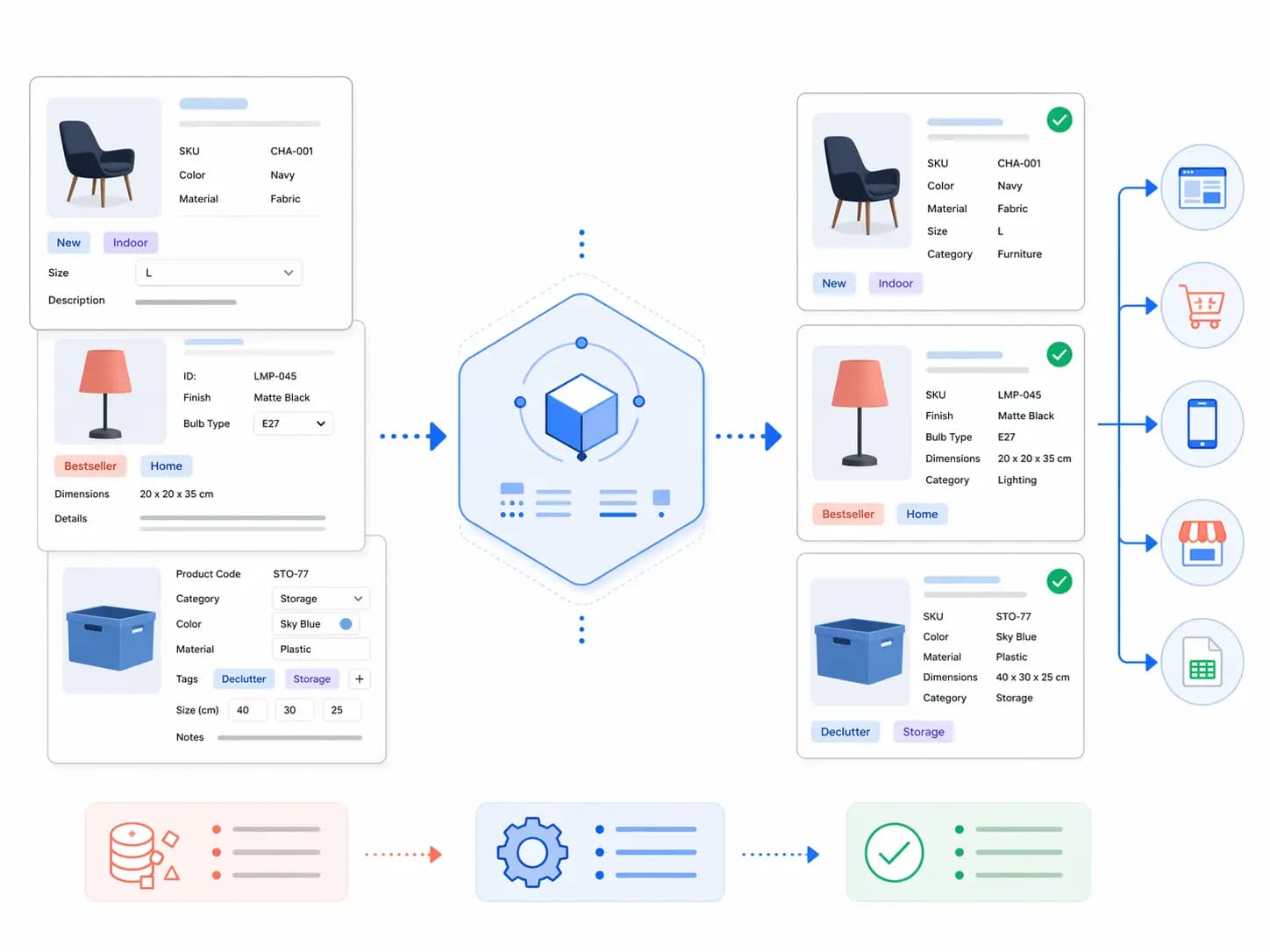
A PIM RFP should reveal whether a platform can run your product operation, not just whether it has a long feature list. The best questions expose how a system handles messy supplier data, approvals, variants, localization, channel rules, and the day-to-day work of keeping a catalog accurate.
Start with your operating model
Before sending an RFP, document your approximate SKU count, number of product families, suppliers, languages, sales channels, users, approval steps, and current pain points. Vendors can only give useful answers when the operating context is clear.
Use this template alongside the PIM platform evaluation scorecard and the PIM implementation guide .
19 questions for a PIM RFP
- How does the data model represent product families, variants, bundles, and configurable products? Ask for a live example using your hardest product family.
- Can we define category-specific attribute sets? The answer should include inheritance, required fields, validation, and exceptions.
- How are supplier values normalized? Look for mappings, controlled vocabularies, units, and traceability back to the source value.
- How are duplicate products and conflicting records detected? Ask which fields are compared and how a user resolves a possible match.
- How are workflows configured? Request an example from import through enrichment, review, approval, and publication.
- Can permissions follow roles and markets? Product, merchandising, compliance, agency, and channel teams may need different access.
- How are changes audited? Confirm version history, user history, rollback, and approval evidence.
- What happens when a required channel field is missing? The system should show actionable exceptions instead of silently publishing incomplete data.
- How are taxonomies mapped to channels? Ask whether mappings are reusable, testable, and maintained separately from the internal taxonomy.
- How are translations and local market overrides handled? Clarify fallback behavior and approval for localized content.
- How are images, documents, and rich media managed? Include renditions, rights, relationships, and channel-specific asset rules.
- What APIs, webhooks, imports, and exports are available? Ask for rate limits, authentication, monitoring, and error handling.
- How does the platform connect to commerce, ERP, DAM, marketplace, and feed systems? Separate native connectors from partner-built integrations.
- How is search and filtering data exposed? Product attributes should remain usable by storefront search and faceted navigation.
- How is performance affected by SKU and user growth? Request relevant customer examples and measurable limits.
- What is included in implementation? Clarify data modeling, migration, mapping, testing, training, and launch support.
- What does support look like after launch? Ask about response times, escalation, documentation, and customer success ownership.
- How is pricing calculated? Request the full model for users, records, channels, environments, API usage, storage, and services.
- What happens if we leave? Confirm data export, media export, taxonomy ownership, and contract renewal terms.
How to score vendor answers
Use a weighted scorecard instead of a simple yes/no checklist. A useful starting point is data model and governance at 25%, workflow and usability at 20%, integrations and channel publishing at 20%, implementation at 15%, performance and security at 10%, and commercial fit at 10%. Adjust the weights to match your risk.
Require a scenario-based demonstration. Give each vendor the same sample: one supplier file, one product family with variants, one missing identifier, one localization request, and one channel-specific requirement. Score the actual steps, not the presentation.
A scenario script for vendor demonstrations
Send every vendor the same script and sample data a week before the demo. Score what they show, not what they say.
- Import. Load one real supplier file with inconsistent units, duplicate rows and a missing identifier.
- Normalize. Show how values are mapped to your controlled vocabulary, with the original value preserved.
- Model. Create a product family with three options and a different image per variant.
- Enrich and approve. Run one product through enrichment, review and approval, and show the audit history.
- Localize. Add a translation with a market-specific override.
- Publish. Send the product to one channel with a required attribute missing and show how the system reports it.
- Break it. Ask them to change an attribute after publication and show what updates downstream.
A 0–3 scoring rubric
| Score | Meaning | Evidence you should see |
|---|---|---|
| 0 | Not supported | Vendor says no, or cannot show it |
| 1 | Workaround or custom work | Needs services, scripting or a partner |
| 2 | Supported with limits | Works in the demo with documented limits |
| 3 | Fully supported | Shown live on your sample data, in standard configuration |
Multiply each score by the criterion weight, then add up the weighted total. Keep the written rationale next to each number so the decision can be explained later.
Red flags in RFP responses
- Every answer is “yes” with no detail or example.
- Roadmap items presented as current capability.
- Key features that depend on “custom development” with no estimate.
- Reluctance to run your sample data or to share a reference customer with a similar catalog.
- Pricing that excludes implementation, connectors or environments.
- No clear answer on data export and exit terms.
A realistic RFP timeline
| Phase | Activity | Output |
|---|---|---|
| Prepare | Document requirements, volumes, stakeholders, pain points | Requirements and scorecard |
| Shortlist | Send the RFP to three to five vendors | Written responses |
| Demonstrate | Scripted scenario demos with sample data | Scored demo sheets |
| Validate | Reference calls, security and commercial review | Risk and cost summary |
| Decide | Weighted scoring and a pilot if needed | Decision record |
Who should be in the evaluation
Include the people who will use the system daily, not just the buyer. A product manager, a merchandiser, someone from IT or integration, a compliance reviewer where relevant, and finance for the commercial review will each spot different risks. Give each person the same scorecard so the results are comparable.
PIM RFP FAQ
How many vendors should be in an RFP?
Three to five is usually enough. More than that increases effort without improving the decision.
Do I need an RFP for a small catalog?
Not always. A lighter process, a requirements list, a scorecard and a scripted demo, can be enough. Use the guide for small and mid-sized stores to scale the process down.
Should I share my budget?
Share your scale and constraints. A budget range helps vendors propose a realistic package, and the PIM pricing guide explains what to compare.
Questions to add for specific situations
The 19 core questions fit most buyers. Add the following when they apply to your business.
| Situation | Extra question |
|---|---|
| Many suppliers | How do suppliers upload, correct and resubmit data, and can they see validation errors without a licence? |
| Multiple brands or regions | How are catalogs, permissions and data separated between brands or regions? |
| Regulated products | How are claims, documents and certificates stored, reviewed and expired? |
| B2B with buyer-specific catalogs | Can different customers see different assortments, specs or documents? |
| Heavy marketplace use | How are marketplace requirements updated, and who maintains the mappings? |
| AI-assisted enrichment | How is generated content reviewed, attributed and approved before it publishes? |
Security and data protection questions
Ask where data is hosted, how it is encrypted in transit and at rest, how access is controlled and logged, which certifications the vendor holds, how backups and recovery work, and how personal data is handled. Request the security documentation before the final round, and involve your security or IT team early.
Ask for references that match your profile
A reference from a similar catalog size, industry and integration landscape is more useful than a flagship customer. Ask each reference what took longer than planned, which features they use daily, and what they would change about the implementation.
Commercial checks before selection
Ask for a three-year total cost view. Include implementation, migration, connector work, internal administration, training, support, and any charges based on users, records, or channels. A lower subscription price can still be more expensive if the operating model needs extensive custom work.
Run your requirements through the PIM Readiness Score before sending the RFP. It gives the buying team a shared baseline and highlights the process gaps that vendors cannot solve for you.
What a strong RFP response looks like
A strong response is specific, demonstrates the workflows, explains limitations, and separates standard capability from roadmap or custom development. Treat vague “yes” answers as follow-up items. The winning platform is the one your team can operate consistently, not the one with the longest feature list.
When you are ready to compare the final commercial proposals, review LynkPIM pricing or book a product data workflow discussion .

PIM workflow connecting supplier product data with ecommerce and sales channels