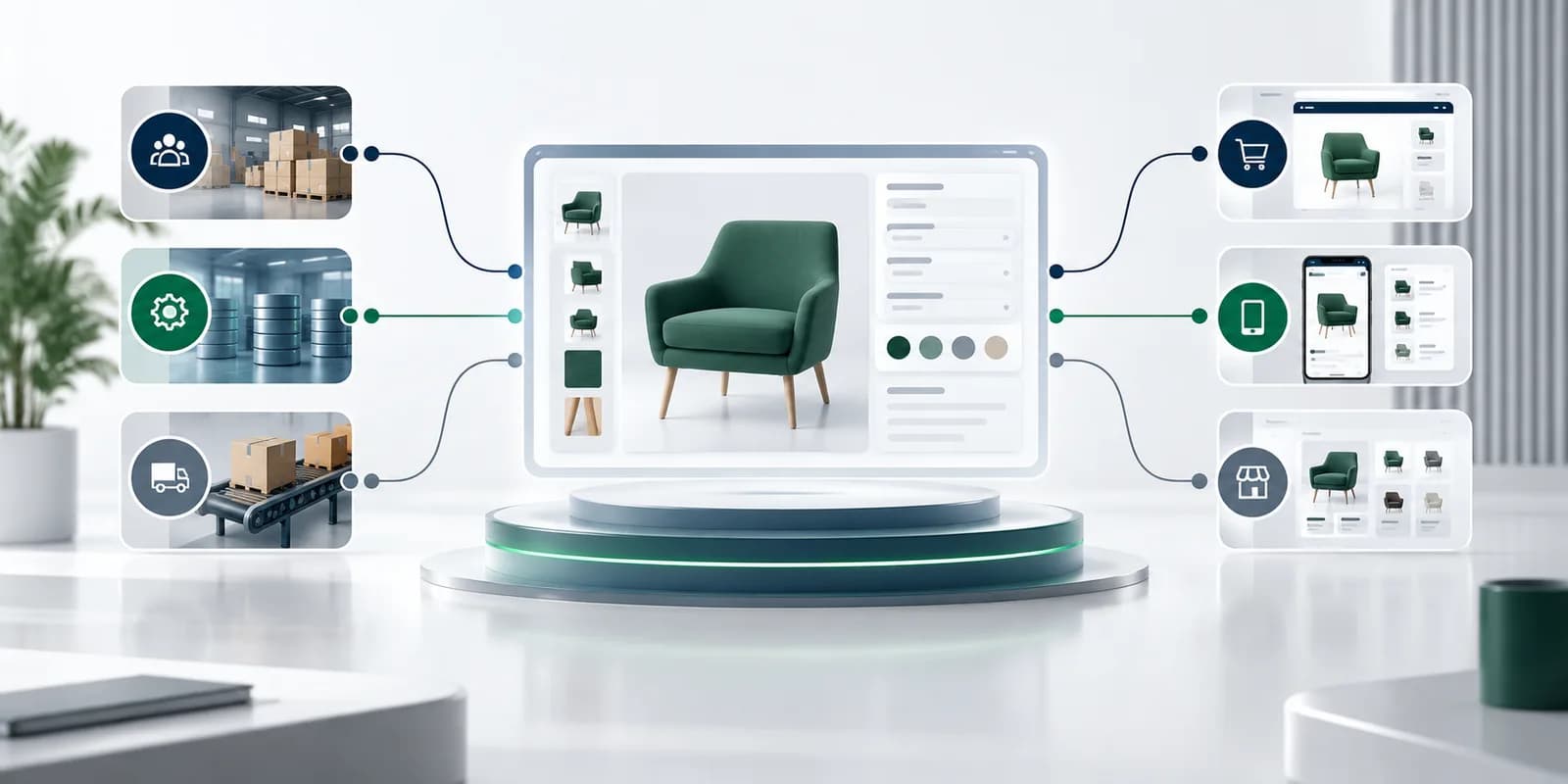
Short answer: A PIM manages the product content you sell with: titles, attributes, variants, copy and channel output. MDM governs master records across business domains such as products, customers, suppliers and locations, using matching, survivorship and stewardship rules. For a growing brand whose problem is product content, a PIM can serve as the product master. MDM becomes necessary when several systems disagree about core records across more than one domain.
PIM and MDM both talk about “one version of the truth” for products, so they often end up on the same shortlist. They are built for different problems. MDM makes sure every system agrees on what a record is. PIM makes sure a product is ready to sell on each channel. Buying the wrong one means either a long governance project that never fixes your product pages, or a PIM stretched into an enterprise data hub.
This guide covers just the PIM and MDM pair in detail. For all four categories in one place, see the PIM vs MDM vs DAM vs PXM overview .
Definitions
- PIM (product information management): a system for building, enriching, validating and publishing commercial product information to storefronts, marketplaces, feeds and partners.
- MDM (master data management): a discipline, usually supported by software, for keeping core business records consistent across systems, often across several domains at once.
- Product MDM: MDM applied to the product domain only. It governs product identity and core operational attributes for systems such as ERP, procurement and warehousing, rather than the selling content.
PIM vs MDM side by side
| PIM | MDM | |
|---|---|---|
| Scope | One domain: products, their variants and their content | Often several domains: products, customers, suppliers, locations, assets, reference data |
| Question it answers | “Is this product complete and right for this channel?” | “Is this the same record everywhere, and which version is correct?” |
| Primary users | Ecommerce, merchandising, content and product operations teams | Data stewards, data governance, IT and enterprise architecture |
| Data types | Attributes, copy, variants, categories, media links, translations, channel mappings | Identifiers, core attributes, hierarchies, relationships between entities, reference codes |
| Governance mechanisms | Enrichment workflows, validation rules, completeness scoring, approvals, channel output rules | Matching, merging, survivorship, stewardship queues, cross-system synchronization |
| Main consumers | Customers, through storefronts, marketplaces, feeds and print | Other systems: ERP, CRM, procurement, warehousing, analytics |
| Typical implementation | Scoped to a catalog and its channels; can start with one category or channel | A cross-functional program with integrations to many source systems and agreed governance policies |
| Typical buyer | Head of ecommerce, digital or product operations | CIO, CDO or data governance lead |
The governance mechanisms, explained
The clearest way to tell the two apart is to look at how each keeps data correct.
MDM: matching, survivorship, stewardship
- Matching finds records in different systems that describe the same real-world thing, even when names, codes or formats differ. Examples: the same supplier entered twice in procurement, or one item with different numbers in two ERPs.
- Survivorship decides which value wins when matched records disagree. For example, the address comes from the most recently verified source, and the unit of measure comes from the ERP. The result is often called a golden record.
- Stewardship gives named people a queue of uncertain matches and conflicts to resolve, with an audit trail of their decisions.
PIM: enrichment, completeness, channel output
- Enrichment adds what a buyer needs: titles, descriptions, attributes, images, translations.
- Completeness checks each product against the rules for its family and target channel, so you can see what is missing before you publish.
- Channel output maps one product record to the fields, categories and formats each storefront or marketplace expects.
MDM reconciles data arriving from many places. PIM completes data and gets it ready for each channel.
Product MDM vs PIM specifically
This is where the line gets blurry, because both hold a product record. The difference is who the record serves.
A product MDM record serves operational systems. It holds the enterprise item identifier, GTINs, units of measure and packaging levels, classification codes, lifecycle status, and links to suppliers, plants or locations. Accuracy and consistency across systems are what count.
A PIM record serves the customer and the channel. It holds the selling title, marketing attributes such as material, fit or compatibility, long and short copy, image order, translations and channel-specific versions. Completeness and fitness for each channel are what count.
Some fields sit in both, such as GTIN, dimensions and weight. The fix is not to pick one system for everything. Give each field a single owner and let every other system read it.
Field ownership: an example
Here is a typical split for a brand running an ERP, a product MDM and a PIM. Yours may differ. What matters is that each field has exactly one owner.
| Field | Owner | Read by |
|---|---|---|
| Cost price, stock levels, purchase orders | ERP | PIM (stock status only, if needed), analytics |
| Enterprise product ID and golden record | MDM | ERP, PIM, warehouse, analytics |
| Supplier relationships and supplier part numbers | MDM | ERP, procurement |
| GTIN, units of measure, packaging hierarchy | MDM (or ERP where no MDM exists) | PIM, channels |
| Selling title, descriptions, bullet points | PIM | Storefronts, marketplaces, feeds |
| Marketing attributes and variant options | PIM | Storefronts, marketplaces, search and filters |
| Channel category mappings and channel-specific copy | PIM | Each channel |
| Translations and localized content | PIM | Localized storefronts and marketplaces |
Three rules keep this workable. Only the owner writes a field. Changes flow outward from the owner and are never edited back in a downstream system. When a value is wrong, the fix happens at the owner, not in the channel.
Signs you need each
You need a PIM if
- product content lives in spreadsheets and store admin panels, and every channel has its own version;
- launches slip because attributes, images or translations are missing;
- marketplaces reject listings for missing or badly formatted fields;
- several people edit product data and nobody can see who changed what.
You need MDM if
- the same customer, supplier or item exists under different IDs in several systems, and reports do not reconcile;
- you have several ERPs, often after an acquisition, with overlapping item and supplier masters;
- the problem spans domains, for example customer-specific assortments that depend on clean customer, product and location records together;
- you need formal stewardship and audit for regulatory or financial reporting.
Can a PIM act as the product master for a mid-size brand?
Yes, for the product domain, as long as you do not have a multi-domain problem. If product records are created in one place, your systems are a manageable set (a storefront or two, some marketplaces, an ERP or accounting system), and you do not need to deduplicate customers or suppliers, the PIM can hold the master product record. It assigns or stores SKUs and GTINs, owns the product content and pushes it out. The ERP keeps cost and stock.
The limits are real, and you should know them before you rely on this setup:
- No other domains. A PIM does not master customers, suppliers or locations, so relationships between those and products stay in the ERP or elsewhere.
- No enterprise matching engine. PIM imports usually match on keys such as SKU or GTIN. They do not resolve fuzzy duplicates across many source systems.
- No survivorship across many sources. If several systems create item records independently, someone has to decide which value wins. That is MDM work.
- Item creation may sit elsewhere. If your ERP creates items first, for purchasing for example, the ERP is the master for identity and the PIM is the master for content. That is fine as long as it is written down.
Sequencing for a growing brand
- Before any system: agree SKU and ID rules and write down who owns which fields. This costs nothing and makes every later step easier.
- PIM: move product content out of spreadsheets. The PIM becomes the product content master, and the ERP keeps cost, stock and orders.
- More systems: as you add a B2B portal, a warehouse system or more marketplaces, define integration contracts per field instead of letting each system edit everything.
- MDM, when it is needed: once duplicates and conflicts across customers, suppliers and products start hurting operations or reporting, an MDM program sits above the PIM and ERP. The PIM keeps doing content.
Two warning signs. Starting with MDM before you have a usable product content process often produces governance with nothing to sell. Starting with a PIM is fine, but watch for it quietly becoming the place where supplier or customer data gets typed in because there is nowhere else to put it.
Where LynkPIM fits
LynkPIM is a PIM, not an MDM. It gives ecommerce teams one governed record per product, published to shops, marketplaces and Google Merchant Center. It includes attributes, product families, variants and bundles, workflows with approvals and change requests, quality rules with completeness scoring and an issues queue, roles and permissions, audit logs and API keys. You can see how products and variants are structured on the product data modeling page.
It does not master customer, supplier or location data, and it has no enterprise matching or survivorship engine. For a mid-size brand with a product-content problem, it can serve as the product master as described above. In a company with an MDM program, it sits downstream and owns the commercial content. If you are still working out the basics, read what a PIM is or see LynkPIM pricing .
FAQ
Is PIM a type of MDM?
Some people describe PIM as product-domain MDM, but in practice they are different. MDM reconciles and governs records across systems. PIM enriches and publishes product content to channels. A product MDM and a PIM can both exist in the same company with a clear split between them.
Do I need MDM if I already have an ERP?
Not necessarily. An ERP is often the de facto master for items, suppliers and customers when it is the only system creating those records. MDM becomes relevant when several systems create or change the same records and they drift apart.
Can one platform do both PIM and MDM?
Some vendors offer both, as one platform or as separate modules. Check which domains are covered, whether matching and survivorship are included, and whether the content workflows suit your ecommerce team, not just your data stewards.
Which should come first, PIM or MDM?
For most growing ecommerce brands, PIM comes first, because the urgent problem is product content and channel output. MDM comes first when the urgent problem is conflicting records across several domains and systems.
What is a golden record?
It is the single trusted version of a record that MDM builds by matching duplicates and applying survivorship rules. Other systems then sync to it. A PIM product record is the trusted version of a product’s selling content, which is related but narrower.
Comparing PIM with asset management instead? See PIM vs DAM .