Product teams selling in the EU are now dealing with several overlapping laws that all ask for more product data: the Ecodesign for Sustainable Products Regulation (ESPR), the Battery Regulation, the Construction Products Regulation, the consumer and repair directives, the packaging rules and existing ecodesign and energy labelling rules. They start on different dates, apply to different products and use different words for similar data. This guide maps how they fit together, shows which one matters for which product, and explains why one well-governed product data foundation can serve all of them. It is written for product, compliance and ecommerce teams and is guidance, not legal advice.
The big picture in one paragraph
The ESPR is the framework. It applies to almost all physical products, but it works product group by product group: nothing binds you until the Commission adopts a delegated act for your group. Sector laws already in force, chiefly the Battery Regulation, set their own dates and passport rules. Around them sit consumer, repair, safety and packaging laws that do not create a passport but do change what you must say, prove and provide. The Digital Product Passport is the shared container for much of this data, which is why building it once is more efficient than building a separate answer for each law.
The main rules side by side
| Rule | Timing | What it does | Who it reaches |
|---|---|---|---|
| Ecodesign for Sustainable Products Regulation (ESPR) Regulation (EU) 2024/1781 | In force since 18 July 2024; product rules arrive group by group through delegated acts | Sets ecodesign requirements and the Digital Product Passport framework, and restricts destruction of unsold goods | Almost every physical product sold in the EU, except food, feed, medicines and type-approved vehicles |
| Batteries Regulation Regulation (EU) 2023/1542 | Battery passport from 18 February 2027 | Battery passport and QR code, carbon footprint, recycled content, labelling and due diligence | Electric vehicle batteries, industrial batteries over 2 kWh and light means of transport batteries (passport); all batteries (labelling) |
| Construction Products Regulation Regulation (EU) 2024/3110 | In force; digital product information phases in through later acts | Replaces the 2011 regulation and adds environmental information and a digital declaration of performance | Construction products |
| Empowering Consumers for the Green Transition Directive Directive (EU) 2024/825 | Applies from 27 September 2026 | Bans generic environmental claims without proof, unverified sustainability labels and misleading durability claims | Anyone who markets products to EU consumers, including online |
| Right to Repair Directive Directive (EU) 2024/1799 | Member States apply it from 31 July 2026 | Repair obligations, repair information and a repair platform in each country | Goods that have EU repairability requirements, such as many household appliances and electronics |
| General Product Safety Regulation Regulation (EU) 2023/988 | Applies since 13 December 2024 | Safety information, traceability and duties for online marketplaces | Consumer products not covered by more specific safety rules |
| Packaging and Packaging Waste Regulation Regulation (EU) 2025/40 | Applies generally from 12 August 2026, with later dates for many measures | Recyclability, recycled content, labelling and reuse requirements for packaging | All packaging placed on the EU market |
| Ecodesign and energy labelling rules Regulation (EU) 2017/1369 and product regulations | Already in force by product line | Energy label, product data in EPREL, and product-specific ecodesign requirements such as repairability for phones and tablets | Appliances, lighting, displays, phones, tablets and other energy-related products |
Dates are taken from the texts and the Commission’s announcements at the time of writing and can be amended, so verify them on the primary sources before acting. The DPP Product Category Lookup lists the status of each product group, with links to the sources, and shows the date it was last reviewed.
The ESPR in detail
What it is
The ESPR entered into force on 18 July 2024 and replaces the older Ecodesign Directive. It widens ecodesign beyond energy use to durability, reparability, recyclability, recycled content, substances of concern and environmental footprint. Its parameters are listed in Annex I, explained in the Annex I guide .
How it becomes binding
The Commission adopts an ESPR working plan that names the priority product groups, then adopts a delegated act for each group. The first working plan, adopted in April 2025, names iron and steel, aluminium, textiles, tyres, furniture and mattresses among its priorities, with iron and steel expected first. Each delegated act sets the requirements, and whether and how the passport applies to that group. See which products need a Digital Product Passport for the timeline by group.
What already applies
Two ESPR elements do not wait for product-group acts. The Commission must set up the Digital Product Passport registry, with the ESPR setting a deadline of 19 July 2026, so check the Commission’s ESPR pages for its current status. And the ban on destroying unsold apparel, clothing accessories and footwear applies to large companies from 19 July 2026, and to medium-sized companies from 2030, with micro and small enterprises exempt. Disclosure rules on discarded unsold goods run alongside it, so check the timing for your company size. If you sell fashion in the EU, review returns and overstock handling now.
The Battery Regulation
Regulation (EU) 2023/1542 is the first passport law with a fixed date. From 18 February 2027, electric vehicle batteries, industrial batteries with a capacity above 2 kWh and light means of transport batteries need a battery passport reached through a QR code. The passport carries chemistry, composition, carbon footprint, recycled content and performance data. Other batteries do not need a full passport but do have labelling and QR-code duties. If you sell products that contain batteries, ask your suppliers which battery category applies and what data they can provide. The wider point for your data model is that batteries are not governed by the ESPR, so the same product can sit under both regimes: the battery under one, the appliance around it under another.
Consumer-facing rules that shape your content
Two directives do not create passports but decide what you can say on product pages and in campaigns.
- Empowering Consumers for the Green Transition Directive (EU) 2024/825 applies from 27 September 2026. It restricts generic environmental claims such as “eco-friendly” or “green” without recognised, demonstrable performance, bans sustainability labels not based on a certification scheme or set by public authorities, and restricts claims based on offsetting. It also targets misleading statements about durability. Every sustainability claim in your product content needs evidence in your data.
- Right to Repair Directive (EU) 2024/1799 applies in Member States from 31 July 2026. It gives consumers repair rights and requires repair information to be provided for covered products. It links directly to the repair and spare part data that passports will carry.
Safety, energy and packaging rules that already apply
- General Product Safety Regulation (EU) 2023/988 has applied since 13 December 2024. It sets traceability and safety information duties, including for online sellers and marketplaces.
- Energy labelling and ecodesign rules already require product data, such as registration of many appliances in the EU product registry (EPREL) and, for smartphones and tablets, repairability and spare part rules. This data is a head start for passport fields.
- Packaging and Packaging Waste Regulation (EU) 2025/40 applies generally from 12 August 2026 and adds recyclability, recycled content and labelling requirements for packaging, which becomes part of your product data too.
- Textile labelling under Regulation (EU) No 1007/2011 already governs fibre composition names and percentages, the base of the textile passport data.
Where the data requirements overlap
The same fields appear across rules. Building each once, with a clear owner and evidence, means each new rule extends the model rather than starting again.
| Data domain | Rules that ask for it |
|---|---|
| Unique product and operator identifiers | ESPR passport, Battery passport, GPSR traceability, EPREL registration |
| Material composition and recycled content | ESPR, Battery Regulation, Packaging Regulation, Construction Products Regulation |
| Substances of concern | ESPR, Battery Regulation, REACH-related duties |
| Carbon and environmental footprint | ESPR, Battery Regulation, Construction Products Regulation, environmental claims rules |
| Repair, spare parts and software updates | Right to Repair Directive, product ecodesign rules, ESPR |
| Durability and lifetime information | ESPR, Empowering Consumers Directive (claims), product ecodesign rules |
| Documentation and declarations of conformity | GPSR, ESPR, sector rules, CE marking |
| End-of-life and recycling instructions | ESPR, Battery Regulation, Packaging Regulation, waste rules |
The eight data domains used for the passport are described in the guide to which data fields belong in a Digital Product Passport , and the DPP Data Field Mapper shows what you hold across them.
Which rules apply to your product: a decision path
- Is the product excluded? Food, feed, medicinal products and type-approved vehicles are outside the ESPR. Their own sector rules apply.
- Is it a battery, or does it contain one? If the battery falls in a passport category, plan for the battery passport by 18 February 2027, separately from the ESPR.
- Is it a construction product? Follow the Construction Products Regulation schedule rather than waiting for an ESPR act.
- Is your product group in the ESPR working plan? If yes, track its delegated act. If not yet, watch the plan’s updates and horizontal measures.
- Do you make environmental or durability claims? The consumer directive already applies to the wording, whatever the product.
- Do you sell repairable goods? Check the repair directive and spare part duties for your product lines.
- Do you sell fashion or footwear? Check the unsold goods rules in the ESPR for your company size.
How to build one foundation for all of them
- One product data model. Define attributes, units and controlled lists once, as described in how to build a DPP data model .
- One identifier scheme. Relate your GTIN, model and unique identifier, and choose how they appear on the data carrier .
- One evidence store. Keep certificates, test reports and declarations linked to each value, so the same proof supports a claim, a passport field and an audit.
- Supplier data collected once. Use a single template as set out in how to collect supplier data for DPP readiness .
- A programme plan. Work through the 30-step ESPR compliance roadmap , and measure your position with the DPP Readiness Assessment .
The full programme view is in the Digital Product Passport guide , and unfamiliar terms are defined in the DPP Terminology Glossary .
Frequently asked questions
What is the difference between the ESPR and the Digital Product Passport?
The ESPR is the regulation, Regulation (EU) 2024/1781. The Digital Product Passport is one of its tools: a structured digital record for a product, reached through a data carrier. The ESPR sets the framework, and delegated acts decide whether and how the passport applies to each product group.
Does the Battery Regulation have its own passport?
Yes. Regulation (EU) 2023/1542 requires a battery passport from 18 February 2027 for electric vehicle batteries, industrial batteries above 2 kWh and light means of transport batteries, accessed through a QR code. It is separate from the ESPR passport.
Do I have to comply with the ESPR now?
Some parts apply already, such as the ban on destroying unsold apparel, clothing accessories and footwear for large companies from 19 July 2026. Product-specific requirements and passports apply only after a delegated act for your product group is adopted and its date arrives.
Which EU rules restrict environmental claims?
The Empowering Consumers for the Green Transition Directive (EU) 2024/825 applies from 27 September 2026. It restricts generic environmental claims without demonstrable performance and unverified sustainability labels.
Which products are outside the ESPR?
Food, feed, medicinal products for humans and animals and vehicles regulated by type-approval law are excluded, and other rules such as food labelling apply to them.
How can one team keep up with several regulations?
Build one product data model with owners and evidence, one identifier scheme and one supplier data process, then extend it as each rule takes effect. Review the regulatory watch every quarter, since dates change.

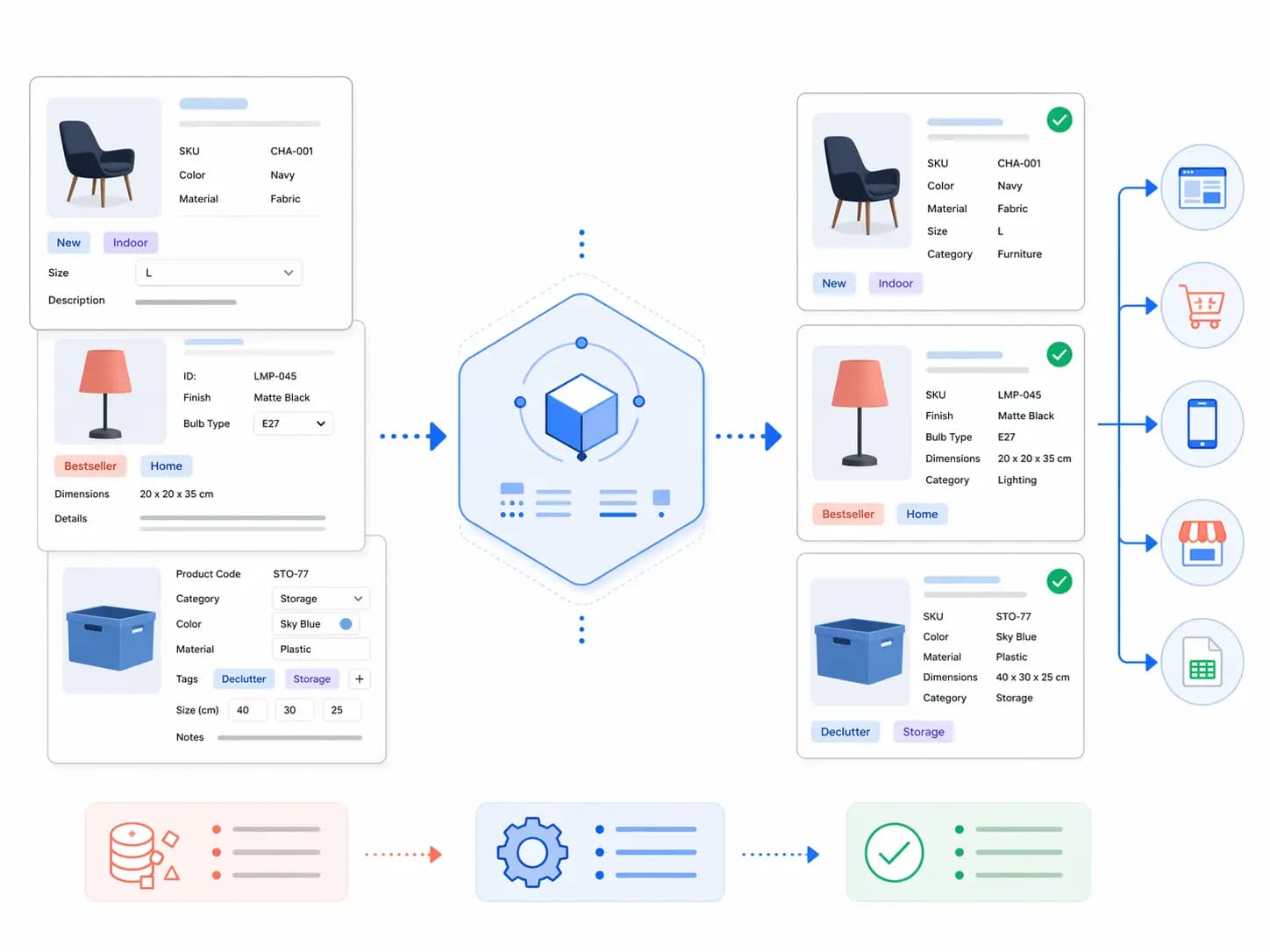
Digital Product Passport data workflow connecting products, materials, suppliers and compliance