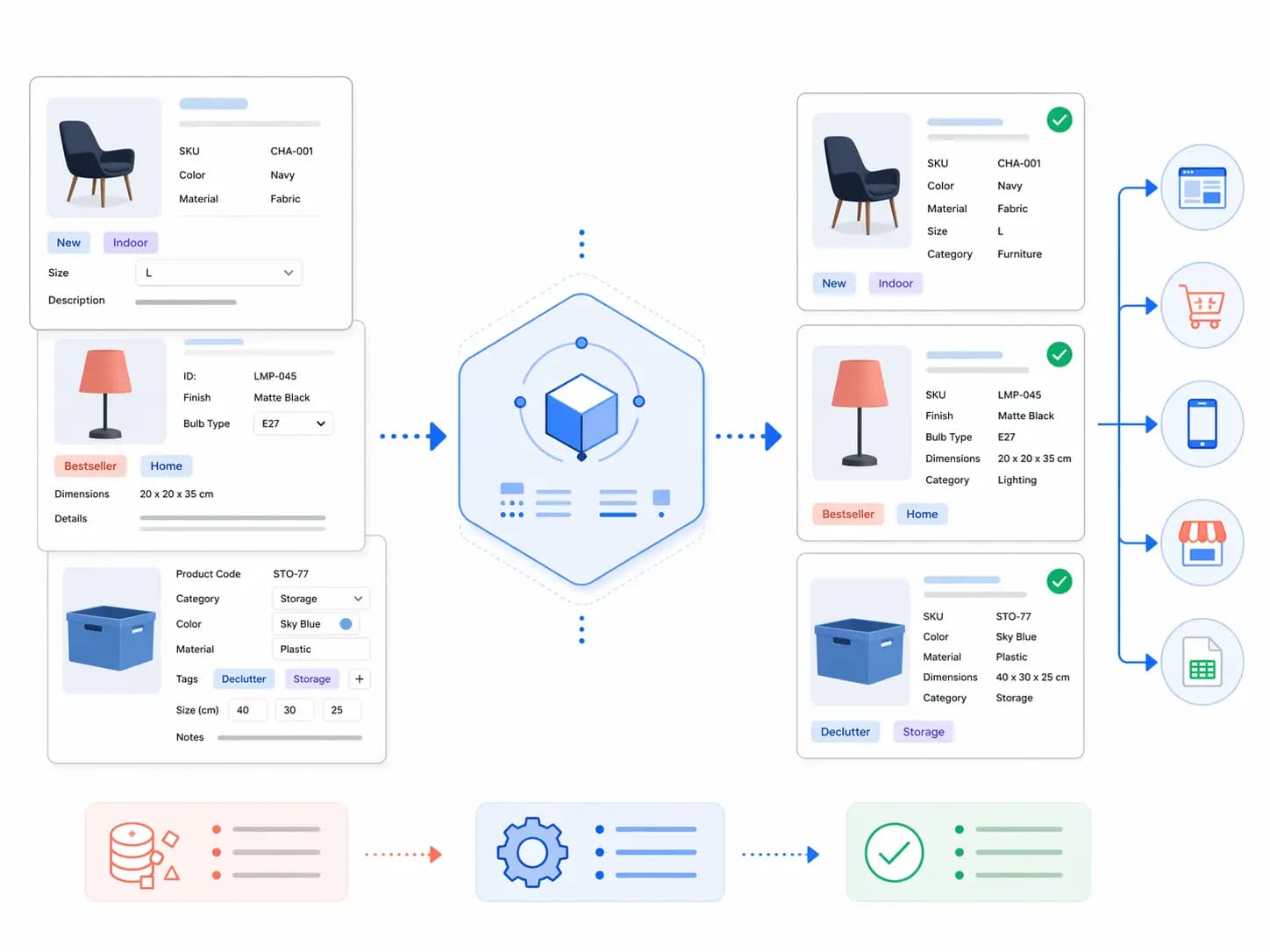
For teams preparing for Digital Product Passport readiness, one question comes up again and again: what is the best PIM approach?
TL;DR: The answer is not simply “buy a PIM. ” The best approach depends on whether the product-information model, supplier workflows, governance, multilingual handling, and publishing preparation are all designed to support Digital Product Passport work in a practical way.
The answer is not simply “buy a PIM.” The best approach depends on whether the product-information model, supplier workflows, governance, multilingual handling, and publishing preparation are all designed to support Digital Product Passport work in a practical way.
A PIM can be one of the strongest operational foundations for Digital Product Passport readiness, but only when it is used as part of a broader product-data strategy rather than as a single-tool shortcut.
This guide explains the best PIM approach for Digital Product Passport readiness, what teams should prioritize first, what a good operating model looks like, and how to avoid common mistakes when trying to use PIM as part of a DPP workflow.
Why “best PIM” is the wrong first question
Many businesses start by asking which PIM platform is best. That is understandable, but it is not usually the most useful first step.
The stronger question is:
What product-information approach will actually make our DPP readiness more structured, more governable, and more maintainable over time?
That matters because a PIM will only help if the business also knows:
- how product data should be structured
- which fields are required by product type
- how supplier data should enter the workflow
- which teams own review and approvals
- how multilingual records should be handled
- how publishable output will be prepared later
Without that clarity, even a strong PIM implementation can turn into another layer of confusion.
What the best PIM approach actually looks like
The best PIM approach for Digital Product Passport readiness is usually not tool-first. It is model-first and workflow-first.
In practice, that means the PIM should support five things well:
- a structured product-data model
- clear field groups and required data rules
- supplier-data organization and review
- workflow, ownership, and readiness control
- multilingual and publishing preparation
When those pieces are in place, PIM becomes a strong operational layer instead of just another product-content repository.
1. Start with product-data design, not software settings
The best PIM approach starts before configuration. It starts with product-data design.
Teams should first define:
- product families and product types
- variant logic
- attribute groups
- supplier-dependent fields
- document relationships
- workflow statuses
- localized-value structure
- publishing-related output needs
This creates the operational blueprint the PIM should support.
That is why this article should connect directly to How to Build a DPP Data Model.
2. Define DPP-related field groups clearly
A strong PIM approach does not rely on one giant undifferentiated field list. It organizes data into meaningful groups that can be governed separately.
For example, field groups may include:
- identity and classification
- technical specifications
- material and composition fields
- supplier-linked values
- documents and evidence
- localized values
- workflow and approval fields
- publishing-related status fields
This makes the PIM much more useful for real readiness work because teams can assign ownership, completeness rules, and review logic by group.
This should link naturally to What Data Fields Should Go Into a Digital Product Passport?.
3. Use PIM as the structured product-data layer, not as the answer to every problem
One of the biggest mistakes teams make is expecting PIM to replace every surrounding process.
The best approach is usually to use PIM as the structured product-information layer inside a wider operating model.
That means:
- supplier relationships still need management
- compliance decisions still need owners
- documents still need review logic
- publishing still needs controlled workflow
- internal team responsibilities still need clarity
PIM supports those workflows by making the product record more organized and trackable. It does not remove the need for them.
4. Prioritize supplier-data normalization early
For many businesses, the best PIM approach is the one that handles supplier-dependent data realistically.
That means the PIM should help teams:
- organize supplier-provided fields
- track missing submissions
- normalize inconsistent values
- separate supplier-submitted and internally approved data
- connect supporting files to the right product records
If supplier-dependent data is still unmanaged, DPP readiness usually stays weaker than it appears.
This should connect to How to Collect Supplier Data for DPP Readiness.
5. Build completeness and readiness logic into the PIM workflow
A good PIM approach should help teams answer an important question quickly: is this product record actually ready?
That usually means the PIM should support visibility into:
- missing required fields
- supplier gaps
- document gaps
- review status
- approval status
- locale-level completeness
- publishability readiness
Without this, the PIM becomes a storage layer but not a readiness layer.
This is why the checklist article matters here: Digital Product Passport Readiness Checklist for Ecommerce Teams.
6. Treat workflow control as part of the PIM approach
The best PIM approach is not only about fields and structure. It is also about how records move through stages.
That means the approach should support:
- who owns which fields or field groups
- who reviews supplier-dependent values
- who approves sensitive information
- how records move from draft to review-ready
- how publishable status is confirmed
- how updates are handled after initial readiness
This is what makes PIM operationally useful instead of just structurally tidy.
This should link to DPP Workflow: Product, Compliance, and Operations Roles Explained.
7. Make multilingual handling part of the core PIM approach
For multi-market businesses, the best PIM approach must include multilingual control from the beginning.
That usually means the PIM should support:
- master product truth
- localized field values
- market-specific extensions where needed
- translation status
- locale-level completeness
- publishability by market or language
If localization is left outside the core PIM approach, readiness becomes much harder to govern across regions later.
This should connect directly to DPP and Multilingual Product Data: What Teams Miss.
8. Design the PIM approach so publishing can come later without rework
Not every business needs full passport-linked publishing immediately. But the best PIM approach should still prepare the data so that controlled publishing is easier later.
That means planning for:
- stable product identity
- publishability status
- record revision awareness
- clean product-to-output relationships
- controlled downstream handoff
This prevents a common mistake where teams later realize the product structure cannot support publishable passport-linked records without another major redesign.
This article should link to How to Publish QR/URL-Linked Digital Product Passport Records.
9. Choose a phased PIM rollout, not an all-or-nothing DPP project
The best PIM approach for DPP readiness is usually phased.
A practical sequence often looks like this:
- Phase 1: structure core product model and field groups
- Phase 2: improve supplier-dependent data intake and normalization
- Phase 3: add completeness and approval workflow
- Phase 4: strengthen multilingual and market-level readiness
- Phase 5: prepare controlled publishing support
This approach helps teams improve the operational foundation step by step instead of trying to solve everything through one large implementation event.
This connects naturally to How to Start DPP Readiness Without Replatforming Everything.
What the best PIM approach is not
It is worth being clear about what does not make a good DPP-supporting PIM approach.
- it is not just adding more fields into an existing messy structure
- it is not copying supplier spreadsheets into a central tool without governance
- it is not treating multilingual content as a later side task
- it is not using PIM without ownership and workflow control
- it is not assuming a new tool will automatically solve weak operational habits
The best approach is structured, intentional, and connected to how the business actually works.
A practical checklist for the best PIM approach to DPP readiness
- Have we designed the product-data model before configuring tools?
- Are field groups defined clearly by product type and workflow need?
- Can supplier-dependent data be organized and reviewed properly?
- Can completeness and readiness be measured?
- Are workflow and approval stages clear?
- Is multilingual handling part of the core design?
- Can the structure support controlled publishing later?
- Are we improving in phases instead of treating this as one giant implementation?
If the answer to many of these is yes, the business is likely taking a strong PIM approach to DPP readiness.
How LynkPIM supports this approach
LynkPIM supports this kind of DPP-oriented PIM approach by helping teams structure product data, define attribute models, organize supplier-dependent values, manage completeness, control multilingual content, support workflow states, and prepare records for more controlled publishing later.
That gives businesses a stronger operational foundation for turning DPP readiness into a structured product-information program rather than a fragmented project.
To connect this article into the wider cluster, link it with the Digital Product Passport Guide, the DPP Readiness Assessment, and How PIM Supports Digital Product Passport Workflows.
Final thoughts
The best PIM approach for Digital Product Passport readiness is not the one with the most fields or the most complexity. It is the one that gives the business a structured, measurable, governable way to manage product information across real workflows.
When the data model, supplier process, workflow control, multilingual handling, and publishing preparation are all aligned, PIM becomes a powerful readiness enabler.
That alignment is what matters most.
FAQ
What is the best PIM approach for Digital Product Passport readiness?
The best approach is usually model-first and workflow-first. That means structuring the product-data model, field groups, supplier handling, completeness rules, multilingual control, and publishing preparation before treating the PIM as a complete answer by itself.
Should teams choose a PIM before designing the DPP data model?
Usually no. The stronger approach is to define the product-data and workflow requirements first so the PIM can be configured to support a practical operating model.
Why is supplier-data handling important in a DPP-oriented PIM approach?
Many DPP-related values come from suppliers, so the PIM approach needs to support structured supplier intake, normalization, review, and visibility into missing or unapproved data.
How does multilingual handling affect the best PIM approach?
For multi-market businesses, multilingual control should be built into the core PIM approach from the start so localized values, translation status, and market-level readiness can be governed properly.
Should publishing be part of the PIM approach even if it comes later?
Yes. Even if QR- or URL-linked publishing comes later, the PIM approach should still prepare stable product identity, readiness logic, and structured output relationships so later publishing does not require major rework.
Can the best PIM approach be phased over time?
Yes. In most cases, a phased approach is better because teams can improve the data model, supplier handling, workflow control, multilingual readiness, and publishing preparation step by step.

By Binu Mathew
CEO @ itmarkerz technologiesBinu Mathew is the CEO of itmarkerz technologies and founder of LynkPIM — a modern product information management platform built for growing e-commerce brands. He has spent years working at the intersection of product data, digital commerce, and catalog operations, helping teams eliminate data silos, enforce quality standards, and publish accurate product content at scale. His work spans PIM strategy, marketplace syndication, and Digital Product Passport compliance.
Use These PIM Tools Next
- Use the PIM Readiness Assessment to Benchmark Your Team
- Check Catalog Health Score Before Expanding Channels
- Audit Required Product Fields with the Completeness Checker
- Validate GTIN, UPC, and EAN Codes Before Publishing
- Assess Team Capability Gaps Before Process Changes
- Evaluate Data Governance Maturity for Scaled Catalog Operations
Build Your Product Data Roadmap
Move from theory to execution with free tools and a practical PIM implementation path.