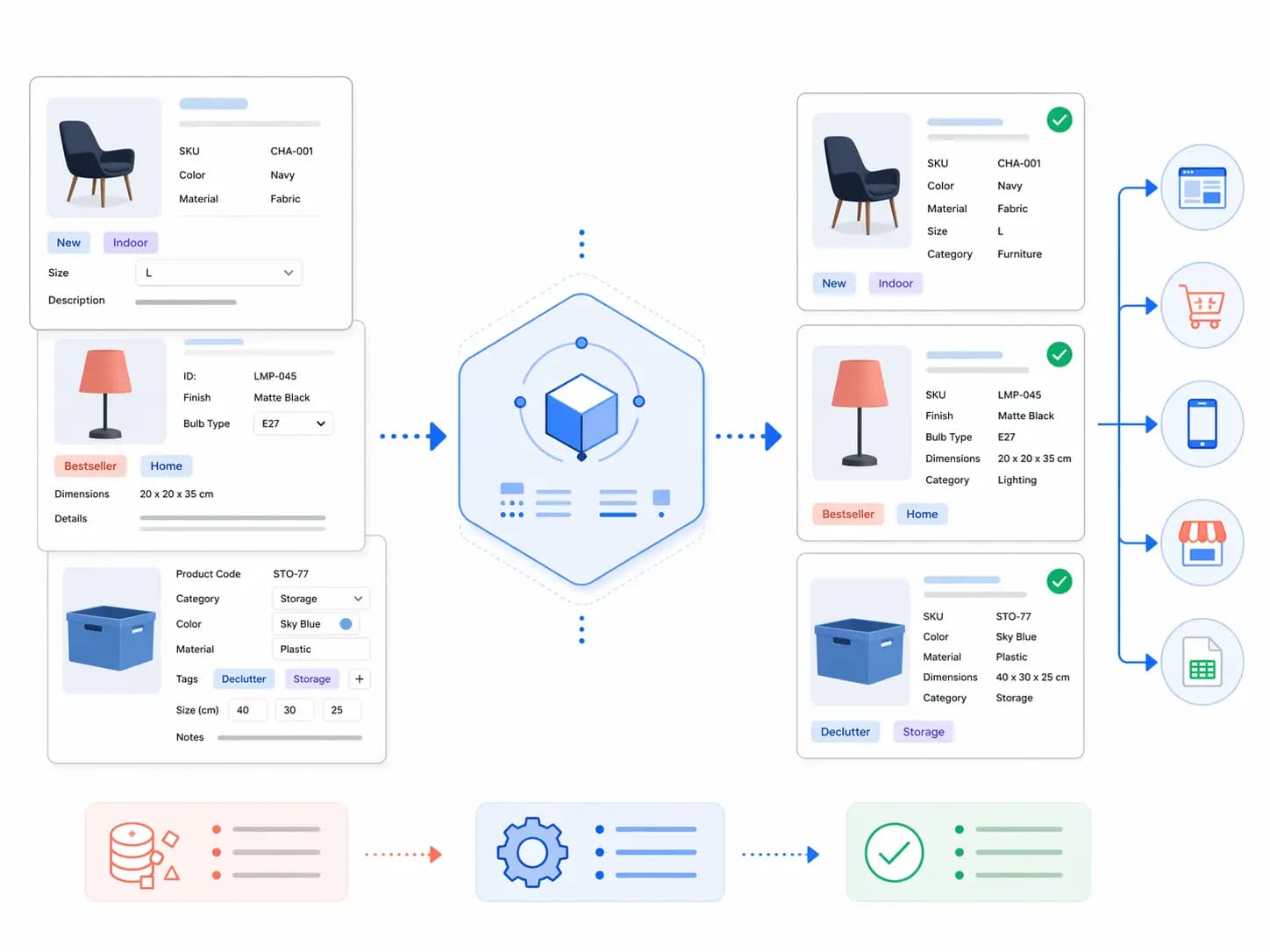
Digital Product Passport readiness is often discussed at a high level, but ecommerce teams usually need something much more practical: a way to assess whether their current product data operations are actually prepared for it.
TL;DR: That is where a readiness checklist becomes useful. Instead of treating Digital Product Passport (DPP) preparation as a vague future project, a checklist helps teams identify what is already in place, what is missing, and what should be prioritized next.
That is where a readiness checklist becomes useful. Instead of treating Digital Product Passport (DPP) preparation as a vague future project, a checklist helps teams identify what is already in place, what is missing, and what should be prioritized next.
This guide gives ecommerce teams a practical Digital Product Passport readiness checklist covering product data structure, supplier data collection, workflow governance, multilingual readiness, and publishing preparation.
The goal is not to claim complete regulatory readiness overnight. The goal is to build an operating model that can support stronger DPP requirements as they become more specific for different product categories.
Why ecommerce teams need a DPP readiness checklist
Many ecommerce businesses already manage large volumes of product information, but that does not automatically mean the business is ready for Digital Product Passport workflows.
In practice, readiness depends on whether your team can do things like:
- collect structured product data consistently
- identify which fields are missing
- govern critical product attributes
- manage supplier-provided information cleanly
- support multilingual or market-specific content
- publish maintainable product records in a controlled way
A checklist helps ecommerce teams move from assumptions to a more realistic view of operational readiness.
How to use this checklist
Use this checklist as a working assessment across product, compliance, sourcing, catalog, and ecommerce teams.
For each section, ask three simple questions:
- Do we already have this in place?
- Is it structured and repeatable?
- Can we scale it across products, suppliers, and markets?
If the answer is “not yet” or “only partially,” that usually points to a real readiness gap—not just a documentation gap.
Section 1: Product data visibility
Before anything else, your team needs visibility into the current state of product information.
Checklist questions:
- Do we know where our product data currently lives?
- Do we know which systems contain core product information?
- Do we know which data points still live in spreadsheets or supplier files?
- Do we know which teams own which parts of the product record?
- Do we know where missing or inconsistent data is most common?
If your organization cannot clearly map where product information lives today, DPP readiness will be difficult because the business does not yet have a clean starting point.
Section 2: Structured product data model
A strong DPP foundation depends on whether product data is structured in a scalable way.
Checklist questions:
- Do we have a defined product data model by product type or category?
- Do we use structured attributes instead of free-text workarounds?
- Do we know which fields are core product facts versus channel content?
- Do we group technical, compliance, and merchandising data clearly?
- Can our structure adapt when more category-specific fields are needed later?
If your catalog structure depends heavily on inconsistent spreadsheets or one-off fields, your product data model is likely not strong enough yet for long-term DPP readiness.
If you want a deeper breakdown of this step, see How to Prepare Product Data for Digital Product Passport Readiness.
Section 3: Required fields and completeness rules
It is not enough to store data. You also need to know whether product records are complete enough to support future passport-linked workflows.
Checklist questions:
- Do we define required attributes by product type?
- Can we identify when a product record is incomplete?
- Do we track missing technical or compliance-related values?
- Can we distinguish “draft” records from “ready” records?
- Do we use validation or completeness scoring to measure readiness?
Without completeness rules, readiness is often based on assumptions, which makes DPP preparation unreliable.
Section 4: Supplier data intake
For many ecommerce businesses, supplier data is the biggest operational challenge in DPP preparation.
Checklist questions:
- Do suppliers provide product information in a standardized format?
- Do we define required fields for supplier submissions?
- Do we have formatting rules for supplier-provided values?
- Do we have a consistent process for handling incomplete supplier records?
- Can we review and normalize supplier data before it enters the main catalog?
- Do we have a way to request missing information efficiently?
If supplier data arrives in uncontrolled spreadsheets, PDFs, and email threads, DPP readiness will remain heavily manual.
Section 5: Governance and ownership
DPP readiness depends on more than data structure. It also depends on who owns the data and how changes are controlled.
Checklist questions:
- Do we know who owns critical product fields?
- Do we know who can create, edit, review, and approve data?
- Do we distinguish between low-risk and high-governance fields?
- Do we log important changes where needed?
- Do we have clear approval steps for sensitive or supplier-dependent fields?
If ownership is unclear, product data quality tends to drift over time, especially when multiple teams are involved.
This is one reason why a structured Digital Product Passport workflow matters operationally—not just from a compliance perspective.
Section 6: Workflow readiness across teams
DPP preparation usually involves more than one department. Ecommerce teams should assess whether the handoffs between teams are clear and repeatable.
Checklist questions:
- Do product, compliance, sourcing, and ecommerce teams have defined responsibilities?
- Do we have a workflow for requesting and validating data?
- Do we know who resolves missing or conflicting data points?
- Can we move records through review stages cleanly?
- Do we have a clear handoff to publishing or public-facing record management?
If responsibilities are handled informally through email and chat, the process is unlikely to scale well.
Section 7: Document and evidence handling
Some product information may depend on supporting files, documents, certificates, or supplier references. Even when those are available, they often remain poorly connected to the actual product record.
Checklist questions:
- Can we associate supporting documents with the correct products?
- Do we know which documents belong to which product families or variants?
- Can internal teams find the right file quickly when needed?
- Do we know when a file is outdated or missing?
- Do we have a process for reviewing document-backed fields?
If important product information depends on disconnected files and unclear references, readiness remains fragile.
Section 8: Multilingual and market-specific readiness
If your business sells across multiple regions, your checklist should include localization readiness from the beginning.
Checklist questions:
- Can we manage translated product content in a structured way?
- Do we know which fields may need localized values?
- Can we track missing translations before publishing?
- Do we support market-specific content where needed?
- Do we avoid mixing core product truth with localized merchandising content?
If multilingual operations are weak today, DPP readiness will become harder in multi-market environments.
This is especially important for teams managing multiple storefronts, localized catalogs, or region-specific content requirements.
Section 9: Publishing readiness
DPP readiness is not just about collecting information. It also depends on whether your business can publish and maintain passport-linked information consistently.
Checklist questions:
- Do we know which product information may need to be public-facing?
- Do we have a controlled process for publishing record updates?
- Can we link product identity to a stable passport-style record?
- Can we update records without creating version confusion?
- Do we have a plan for QR- or URL-linked access if needed later?
If publishing is treated as a manual afterthought, DPP readiness tends to remain theoretical instead of operational.
Section 10: Change management and ongoing maintenance
DPP readiness is not a one-time project. Product records change over time, and your operating model needs to support that reality.
Checklist questions:
- Do we have a way to update important product information cleanly?
- Do we know how record changes are reviewed?
- Can we identify which products are affected when requirements change?
- Do we have a way to avoid stale public-facing information?
- Do we treat readiness as an ongoing capability rather than a one-time file exercise?
This is often where businesses realize they need stronger product operations infrastructure, not just a temporary compliance workaround.
A simple DPP readiness scoring model
To make this checklist easier to use, score each question like this:
- 0 = not in place
- 1 = partially in place
- 2 = clearly in place and repeatable
You can then assess readiness by section:
- 0–4 = major gap
- 5–8 = developing capability
- 9–10+ = stronger operational maturity
This kind of scoring helps teams move from vague discussion to practical prioritization.
What to do if your score is low
A low readiness score is not a failure. It is a useful signal.
It usually means your next priorities should be:
- auditing where product data lives
- standardizing product attributes
- improving supplier data collection
- adding completeness rules
- clarifying ownership and approvals
- designing a cleaner publishing workflow
That is exactly the kind of work that builds real readiness over time.
How LynkPIM helps ecommerce teams assess and improve DPP readiness
LynkPIM helps ecommerce teams move toward Digital Product Passport readiness by making product data more structured, governable, measurable, and publishable.
That includes support for:
- structured product attributes
- catalog organization
- completeness tracking
- workflow and approval control
- multilingual product data
- more controlled publishing preparation
If you want to evaluate your current state, start with LynkPIM’s DPP Readiness Assessment and then explore the Digital Product Passport Guide for a broader operational view.
Final thoughts
Digital Product Passport readiness becomes much more manageable when ecommerce teams stop treating it as an abstract future requirement and start assessing it as a product data operations capability.
A checklist helps you see where the real gaps are: structure, ownership, supplier intake, workflow clarity, multilingual readiness, and publishing control.
That is where practical DPP work begins.
FAQ
What is a Digital Product Passport readiness checklist?
A Digital Product Passport readiness checklist is a practical way to assess whether your current product data, supplier workflows, governance model, and publishing processes are strong enough to support DPP-related requirements as they evolve.
Why do ecommerce teams need a DPP checklist?
Ecommerce teams often manage product data across many systems and suppliers. A checklist helps identify operational gaps before DPP preparation becomes urgent or difficult to manage at scale.
What should a DPP readiness checklist include?
A strong checklist should cover product data visibility, structured attributes, completeness rules, supplier intake, governance, workflow design, multilingual readiness, publishing readiness, and ongoing maintenance.
Can a small ecommerce team use this checklist?
Yes. Smaller teams may not need complex workflows immediately, but they still benefit from assessing product data structure, supplier data consistency, and future publishing readiness early.
What if our current readiness score is low?
A low score usually means there are real operational gaps to fix, such as fragmented data, unclear ownership, weak supplier intake, or missing completeness rules. That gives you a clear starting point for improvement.
Where should we start after using this checklist?
Start with your product data structure, supplier intake process, ownership model, and readiness rules. These areas usually create the strongest foundation for longer-term DPP preparation.

By Binu Mathew
CEO @ itmarkerz technologiesBinu Mathew is the CEO of itmarkerz technologies and founder of LynkPIM — a modern product information management platform built for growing e-commerce brands. He has spent years working at the intersection of product data, digital commerce, and catalog operations, helping teams eliminate data silos, enforce quality standards, and publish accurate product content at scale. His work spans PIM strategy, marketplace syndication, and Digital Product Passport compliance.
Use These PIM Tools Next
- Use the PIM Readiness Assessment to Benchmark Your Team
- Check Catalog Health Score Before Expanding Channels
- Audit Required Product Fields with the Completeness Checker
- Validate GTIN, UPC, and EAN Codes Before Publishing
- Assess Team Capability Gaps Before Process Changes
- Evaluate Data Governance Maturity for Scaled Catalog Operations
Build Your Product Data Roadmap
Move from theory to execution with free tools and a practical PIM implementation path.